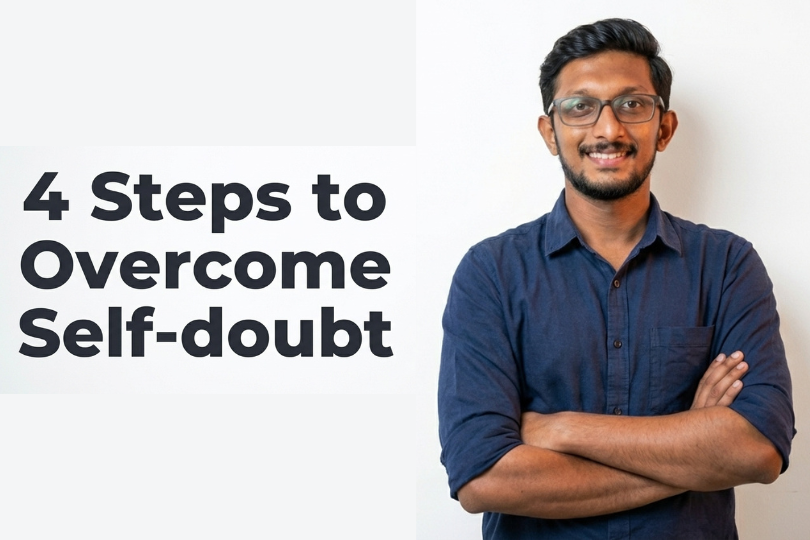
Do you struggle with Self-doubt? Have you ever stood in front of a mirror and wondered if you are good enough?
Maybe before a test, a new job, or sharing an idea, a quiet voice inside whispered that you might fail. That voice is often called self-doubt, and almost every human being hears it at some point. It is not loud like a shout. It is soft, sneaky, and powerful because it talks to us in our own voice.
While the word ‘Overcome’ in the blog title may picture an image of someone completely devoid of self-doubt, I use this word as a means to overcome the shame and fear associated with self-doubt, not self-doubt itself. Because it is impossible for any human being to live a life without self-doubt. We understandably can’t see the future, and accordingly cannot modify or alter what happens. For as long as we don’t have access to that dimension, we will always be challenged by life in a way that humbles us. The best we can do is to assure ourselves that no matter what happens, we will rise and give our utmost best.
This blog is a gentle guide to understanding that voice and learning to work with it rather than fight it. You will learn four simple but deep steps that anyone can follow. These steps are easy enough for a child to understand, yet strong enough to help adults change their lives. Think of this as a journey inward, where your body, mind, and heart all get a chance to speak.
Contents
- 1 How does life coaching help you overcome self-doubt?
- 2 Step 1: Awareness of Self-Doubt in the Body
- 3 Step 2: Alignment Beyond Self-Doubt
- 4 Step 3: Action Through Self-Doubt and Fear
- 5 Step 4: Integration of Self-Doubt and the Past
- 6 Bringing the Four Steps Together
- 7 Finding the Found Program
- 8 Contact me
- 9 Common Queries Answered
How does life coaching help you overcome self-doubt?
My role as a life coach in helping clients overcome self-doubt begins with fully understanding the context of the client. This means listening deeply to their story, their experiences, and the moments when they began to question themselves. Together, we look at how their thoughts, emotions, and body responses are connected. Life coaching creates a safe space where clients can speak honestly without fear of judgment.
From there, we gently uncover hidden beliefs that no longer serve them and replace them with clearer, kinder perspectives. Through simple reflection, guided questions, and small actions, clients begin to trust themselves again. Over time, self-doubt stops feeling like a wall and starts feeling like a doorway to growth. Life coaching does not give answers but helps clients discover their own inner wisdom and strength.
Step 1: Awareness of Self-Doubt in the Body
The first step is awareness. Awareness means noticing what is happening without trying to fix it right away. Many people think uneasy feelings live only in the mind, but they also live in the body. When self-doubt shows up, your body often reacts before your thoughts do.
Pause for a moment and imagine a time when you felt unsure of yourself. What did your body do?
- Did your jaw feel tight, like you were biting down?
- Did your shoulders move up toward your ears?
- Did your palms feel sweaty or cold?
- Was there a churning or heavy feeling in your stomach?
- Did you feel like hiding or shrinking?
- Did feelings of shame or guilt appear without warning?
These are not random reactions. They are signals. Your body is trying to protect you from something it thinks is dangerous, even if that danger is only an idea.
This blog is written by Abhijit Shankaran, a certified life coach and mental fitness enabler. He is also
a content writer and digital marketing expert.
Listening to Self-Doubt Without Judgment
When you notice these signals, do not scold yourself. Do not say, “I should not feel this way.” Instead, act without judgment. Observe with curiosity. You might even place a hand on the part of your body that feels uneasy and breathe slowly.
By doing this, you begin to see patterns. You may notice that certain thoughts, people, or situations bring up the same tight feeling again and again. This is how awareness grows. You start to understand that these reactions are learned responses, not proof that something is wrong with you.
Awareness is powerful because you cannot change what you cannot see. Once you notice where and how this feeling lives in your body, it loses some of its control.
Step 2: Alignment Beyond Self-Doubt
The second step is alignment. Alignment means bringing your thoughts, feelings, and actions into the same direction. When self-doubt is strong, it often means something inside you is not in sync.
This step needs quiet time and honesty. Take a pen and paper and sit somewhere comfortable. Answer these questions slowly, without rushing.
- Why do I feel unsure of myself in this situation?
- What emotions does this bring up in me?
- Why does this feeling matter so much to me?
As you write, you may discover that the uneasy feeling is connected to something important. Maybe you care deeply about doing well. Maybe you want to be seen, respected, or loved. These desires are not weaknesses. They are signs of what matters to you.
When you understand why you feel the way you do, you also understand your values. Values are like a compass. They show you what feels true and meaningful. Alignment happens when your goals match these values.
Ask yourself another gentle question. When do I feel most like myself? When do my body and mind feel calm and strong at the same time? That feeling of being in sync is your guide.
Step 3: Action Through Self-Doubt and Fear
The third step is action. This may sound scary, because taking action often brings the very feeling we want to avoid. Self-doubt is deeply connected to the fear of failure, fear of being laughed at, or fear of getting things wrong.
But think about a toddler learning to walk. The child falls many times. They wobble, tumble, and sometimes cry. Yet they stand up again. They do not say, “I am bad at walking.” They keep going because learning is part of the process.
Growth works the same way for us.
Instead of waiting to feel confident, make a commitment to learn. Tell yourself that mistakes are allowed. When you remove the rule that says you must be perfect, you create space to move.
Yes, people may judge or criticise. That can hurt. But when you learn to work with fear instead of trying to erase it, something surprising happens. Fear becomes a teacher. It points to areas where you care deeply and where you have untapped strength.
Action does not mean giant leaps. It can be one small step. Speak up once. Try again. Learn from what did not work. Each step builds trust in yourself.
Step 4: Integration of Self-Doubt and the Past
The final step is integration. Integration means bringing all parts of yourself together, even the parts you wish were different. This includes your past self.
Self-doubt often grows from old memories. Times when you failed. Moments when someone said you were not enough. Experiences where you felt small or invisible. These moments can form beliefs that stick around long after the event is over.
Integration teaches forgiveness. Not forgiveness as punishment or sin, but forgiveness as letting go. The old meaning of the word forgive is “to forego.” To release your grip.
You are not erasing the past. You are choosing not to let it define you.
In this step, you learn a new kind of success. Not success based only on results, but success based on effort and presence. You still work toward goals. You still care about outcomes. But your worth is not tied to winning or losing.
You begin to see success and failure as part of the same journey. They are events, not identities. This creates a greater sense of self, one that can hold joy, disappointment, courage, and rest all at once.
When you accept your past self, you stop fighting your own story. And when the fight ends, energy returns.
Bringing the Four Steps Together
Awareness helps you notice. Alignment helps you understand. Action helps you grow. Integration helps you heal.
Together, these steps form a cycle you can return to again and again. Each time, your relationship with self-doubt changes. It becomes less of an enemy and more of a signal. A sign that something important is happening inside you.
Imagination plays a role here. Imagine carrying a heavy backpack filled with old fears and beliefs. Each step you take helps you unpack one item. The walk becomes lighter. The path becomes clearer.
You do not need to rush. You do not need to be fearless. You only need to be willing to listen, align, act, and let go.
If you could speak to your younger self today, what would you say? Perhaps you would offer kindness instead of criticism. Perhaps you would say, “You are allowed to learn.”
That message is still true now.
By practising these four steps, you create a life where uncertainty does not stop you. Instead, it invites you to grow.
Finding the Found Program
The ‘Finding the Found‘ program is my flagship gentle 4-week life coaching program. There are 4 personalised 1:1 sessions, one per week. Each session focuses on each of the 4 stages mentioned in this blog – Awareness, Alignment, Action and Integration.
All sessions are held online. For offline sessions, please contact me, and we can work out a way to fulfil your request.
Contact me
Get in touch with me for a personalized life coaching journey. Sessions are held online/offline.
To get started, reach out to me. My contact details are below
Abhijit Shankaran
Bengaluru, Serves globally
(+91) 8939920025
abhijitshankaran@gmail.com
Common Queries Answered
What is a life coach?
Why do I need a life coach?
Types of life coaching
Emotional intelligence coaching
Stress Management Strategies
Life Coaching for self-improvement
Top 10 Life Coaches in India
Does life coaching really work?
Life coaching for confidence building