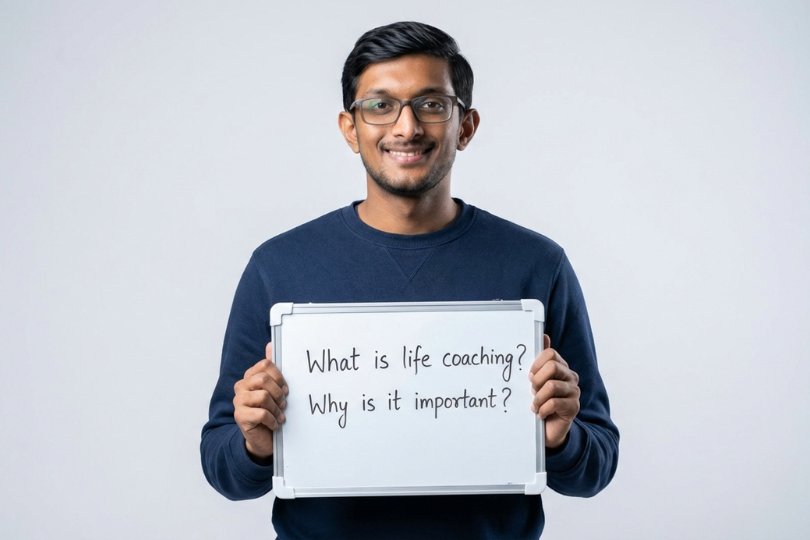
Life coaching isn’t about being invincible. It is about being. When someone asks you to tell them something about yourself, you begin with what you do and where you are from. Sadly, we are conditioned to think that what you do and where you come from is equal to who you are. In doing so, you try to chase success and excellence in both; you are either trying to constantly become a better version of yourself or trying to become the best at something you do.
The issue in this is that your achievements and failures constantly dictate you. Life is by nature such that we experience more failure than success. In the process, it is very easy to associate our identity and self-worth so that “I failed at math” becomes “I am a failure.” This jump from failing at something to becoming that is exactly what life coaching tries to undo. Doing comes from being. To do, one has to first be. This beingness is not a case of meditative stillness, but fully accepting yourself. That then begs the question, why improve at all at anything if I am fully accepting of my weaknesses and strengths?
Well, the truth is, you are again confusing being and doing. With doing, there is always scope for improvement. Being there is no negotiation. Everything you think being is stems from doing and from wanting to do better, be faster, or wanting more. With life coaching, the goal is to see yourself for who you are. Who you are is truly unique. It can hence not be put into a checklist. The best we can do is take off everything we are not to find who we truly are. We find that it was always there, ordinary, simple, and yet so powerful, your beingness.
Contents
- 1 What is life coaching, and how is it different from therapy or mentoring
- 2 Why the distinction between being and doing matters
- 3 What happens inside a coaching engagement
- 4 Benefits you can reasonably expect
- 5 Why is life coaching important now
- 6 The pillars of an effective coaching process
- 7 Common myths that keep people from starting
- 8 How to choose the right coach for you
- 9 A practical roadmap for your first 90 days
- 10 Frequently asked questions
- 11 Returning to being
- 12 Final note on identity and improvement
- 13 Contact me
- 14 Common Queries Answered
What is life coaching, and how is it different from therapy or mentoring
People often assume that life coaching is a lighter version of therapy or a more personal form of mentoring. In reality, it has its own foundation. Therapy often focuses on healing the past and alleviating clinical symptoms. Mentoring involves a subject matter expert sharing a path based on experience. Coaching is a collaborative and forward-looking process that honours you as a whole, capable person who can generate their own insights with the right questions, presence, and accountability.
At its core, coaching is about clarity, choice, and change. A coach does not fix you because you are not broken. A coach meets you where you are, helps you name what matters, reveals patterns that keep you stuck, and supports you in building structures that move your intentions into consistent action. The sessions become a structured space where you tell the truth to yourself and then act in alignment with that truth.
It is important to understand that what coaches do, is working from your present towards building the ideal future we want.
Why the distinction between being and doing matters
Consider two inner statements. The first is, “I will work out five days a week.” The second is, “I am someone who honours my body.” The first lives in doing. The second arises from being. When your actions arise from being, consistency flows more naturally because your choice is anchored in identity, not performance. This is the philosophical ground on which effective life coaching rests.
Being is unconditional. Doing is conditional. When you pin your identity to performance alone, failures become identity wounds. When you honor being as primary, failures become information, not verdicts. In coaching, this shift is not abstract. It shows up in how you schedule your week, how you handle setbacks, how you ask for help, and how you celebrate progress even when outcomes are still unfolding.
What happens inside a coaching engagement
Although every coach brings a distinct presence and method, most engagements follow a thoughtful arc.
- Discovery and intentions
You clarify the areas that matter now. Career crossroads, relationship patterns, health rhythms, creative expression, confidence and boundaries, money beliefs, or leadership presence. You do not need to fix everything at once. You choose a meaningful few. - Values and vision
You articulate what matters most beyond trends and comparisons. Rather than a fuzzy future, you shape a vivid picture of the life that would feel honest and alive for you. - Current reality and patterns
Together you study your habits, triggers, and stories. You notice where you avoid, over-prepare, or self-criticise. You name the protective strategies that served you before but cost you now. - Experiments and structures
You run small, testable experiments that reduce fear and increase momentum. You add structures such as weekly reviews, accountability check-ins, environment design, and time boundaries. - Integration and identity shift
You track evidence that the new way is becoming normal. You build confidence by keeping promises to yourself and recalibrate your goals from a grounded centre.
Across this arc, life coaching is not a lecture. It is a dialogue that respects your agency and amplifies your awareness.
Benefits you can reasonably expect
While results vary by person and context, certain benefits consistently arise when people engage with life coaching wholeheartedly:
- Clarity you can act on
You learn to distinguish between shiny wants and deep wants. This reduces decision fatigue and increases momentum. - Clean agreements with yourself
You shift from vague intentions to specific commitments that honor your energy, time, and priorities. - Sustainable habits
Rather than boom and bust cycles, you design habits that fit your real life. You track signals that tell you when to push and when to rest. - Better conversations
You practice boundaries, requests, and feedback without guilt. Relationships get lighter because you stop over-promising and under-resourcing. - Emotional regulation
You build skills to sit with discomfort, name feelings accurately, and choose responses that reflect your values.
For a deeper dive into common outcomes and use cases, explore this summary of the https://abhijitshankaran.com/benefits-of-life-coaching/, which highlights personal growth, accountability, and practical habit design.
Why is life coaching important now
We live in an age of ambient comparison. Infinite feeds whisper that your life should be elsewhere. Under that pressure, people often outsource their sense of enoughness to the next achievement. The result is a fragile confidence that spikes and crashes with every metric. Life coaching interrupts this loop by teaching you to hold two truths at once. I am fully worthy as I am. I am also free to improve how I live.
This paradox matters because improvement without acceptance becomes self-rejection in disguise. Acceptance without improvement can slide into resignation. Coaching integrates both. You honour who you are and you practice new ways of living that express who you are. The point is not to become someone else. The point is to express yourself more honestly and consistently in the world you inhabit.
The pillars of an effective coaching process
Presence
Presence is the quality of attention that says you matter right now. In a coaching session, presence calms urgency and allows your deeper answers to surface. You speak slower. You hear yourself better. Your body offers clues you usually miss.
Inquiry
Powerful questions loosen rigid stories. What is the payoff of staying stuck. What do you gain by saying yes when you want to say no. What becomes possible if you accept the part of you that is afraid and move anyway. Inquiry is not interrogation. It is the art of meeting your life with honest curiosity.
Practice
Insight without practice fades. Coaching turns insight into repetition. Five-minute daily actions can beat occasional heroics because consistency compounds. Your coach helps you design practices you can actually keep.
Accountability
Accountability is not punishment. It is companionship with your future self. Structures like weekly check-ins, habit trackers, and environment tweaks keep your goals visible and doable.
These pillars do not replace your wisdom. They organize your wisdom into motion. That is why life coaching feels both gentle and powerful when done well.
Common myths that keep people from starting
Myth 1. Coaching is only for people who lack discipline.
Coaching is for people who want their discipline to serve the right aims. Many high performers use coaching to reduce friction, improve focus, and prevent burnout.
Myth 2. A coach tells you what to do.
A good coach helps you hear what you already know and then commit to it with less noise and more support.
Myth 3. Coaching is expensive relative to the benefit.
When coaching changes a daily habit or a monthly choice, the compounded benefit across a year can be significant. People often recoup their investment through improved decisions, time saved, and reduced stress.
Myth 4. You must have a perfect goal before you begin.
Starting with curiosity is enough. Many clients refine their goals in the first few sessions as clarity emerges.
How to choose the right coach for you
Choosing a coach is an act of respect for your future. Consider these factors before you commit.
- Chemistry and trust
Most coaches offer a short discovery call. Use it to sense whether you feel seen and safe. Tools and credentials matter, but the relationship creates the change. - Method and structure
Ask how sessions flow, what happens between sessions, and how progress is tracked. Clear structure leaves more room for honest work. - Experience with your context
You do not need a coach from your industry, but you may value someone who has coached similar transitions such as career pivots, leadership growth, or creative recovery. - Boundaries and ethics
Expect clear agreements about confidentiality, scope, and referrals if therapeutic issues arise. Ethical coaches know when to bring in other professionals. - Your readiness
Coaching is a team sport. Your willingness to do small weekly actions is a better predictor of success than any tool. If you are ready to show up, life coaching can be a strong ally.
For a straightforward explanation of roles and expectations, revisit this guide on https://abhijitshankaran.com/what-is-a-life-coach/.
This blog is written by Abhijit Shankaran, a certified life coach and mental fitness enabler. He is also
a content writer and digital marketing expert.
A practical roadmap for your first 90 days
The first three months set the tone. Here is a simple plan you can adapt.
Weeks 1 to 2. Orientation and intentions
Write a brief life snapshot. What is working. What is costly. Choose three intentions. Example, improve sleep, pursue a role that fits, express boundaries with kindness.
Weeks 3 to 4. Values and design
Name your top five values and define them in your words. Translate each value into one weekly practice. Example, if health is a value, schedule your walks the way you schedule meetings.
Weeks 5 to 8. Experiments
Run small experiments that test assumptions. Apply for one role that excites you. Say no once a week to a low priority request. Track how you feel before and after.
Weeks 9 to 12. Integration
Audit your calendar and habits. Keep what helps, drop what drains, and refine one system such as your morning setup or your meeting boundaries. Celebrate visible wins and invisible wins such as better self talk.
Across this roadmap, life coaching acts as a supportive scaffold. You do the living. The coach provides the mirror, the nudge, and the rhythm that make change feel humane.
Frequently asked questions
Is coaching right for me if I already read self help books
Books provide ideas. Coaching turns one idea into a weekly behavior with accountability. If you have read enough and want to live more, the timing is good.
How soon will I see results
Some changes are immediate because you start telling the truth. Other changes take weeks as new habits settle. Expect early clarity, then gradual compounding.
What if my goals change mid way
That is a sign of growth. Coaching is flexible. You refine as you learn more about what truly matters.
Can coaching and therapy run together
Yes, many people benefit from both. Therapy can heal past wounds while coaching supports present action. Your coach will help you maintain healthy boundaries between the two.
What if I am afraid to fail again
Then you are human. Coaching reframes failure as feedback and helps you create safe experiments that build confidence through action, not bravado.
Returning to being
Let us return to where we began. The world will keep praising doing. The world rarely teaches being. Yet it is being that quietly shapes every act that lasts. When you accept your ordinary, you tap a power that is not loud but it is steady. From there, you choose work that fits, you speak with care, you rest without guilt, and you learn with patience. You do not become someone else. You become more yourself in public.
This is the quiet gift of life coaching. It is not about adding more polish to your mask. It is about setting the mask down and then choosing your actions with a clearer face. In that sense, coaching is not a luxury. It is a practice of honest living in a noisy age.
If you want to understand outcomes and practical use cases, read this short overview of the https://abhijitshankaran.com/benefits-of-life-coaching/. If you want to understand the role and approach of a coach before booking an intro session, this primer on https://abhijitshankaran.com/what-is-a-life-coach/ is a useful next step.
Final note on identity and improvement
You are not your resume. You are not your last mistake. Improvement is noble when it is chosen from acceptance. Improvement becomes cruelty when it is demanded by shame. The work of life coaching is to help you practice the first and retire the second. When being holds doing, progress no longer threatens your worth. It expresses it.
When that shift lands, your goals stop sounding like bargains for love. They start sounding like promises to a life you are honoured to live.
Contact me
Get in touch with me for a personalized life coaching journey. Sessions are held online/offline.
To get started, reach out to me. My contact details are below
Abhijit Shankaran
Bengaluru, Serves globally
(+91) 8939920025
abhijitshankaran@gmail.com
Common Queries Answered
What is a life coach?
Why do I need a life coach?
Types of life coaching
Emotional intelligence coaching
Stress Management Strategies
Life Coaching for self-improvement
Top 10 Life Coaches in India
Does life coaching really work?
Life coaching for confidence building
Trackbacks/Pingbacks