
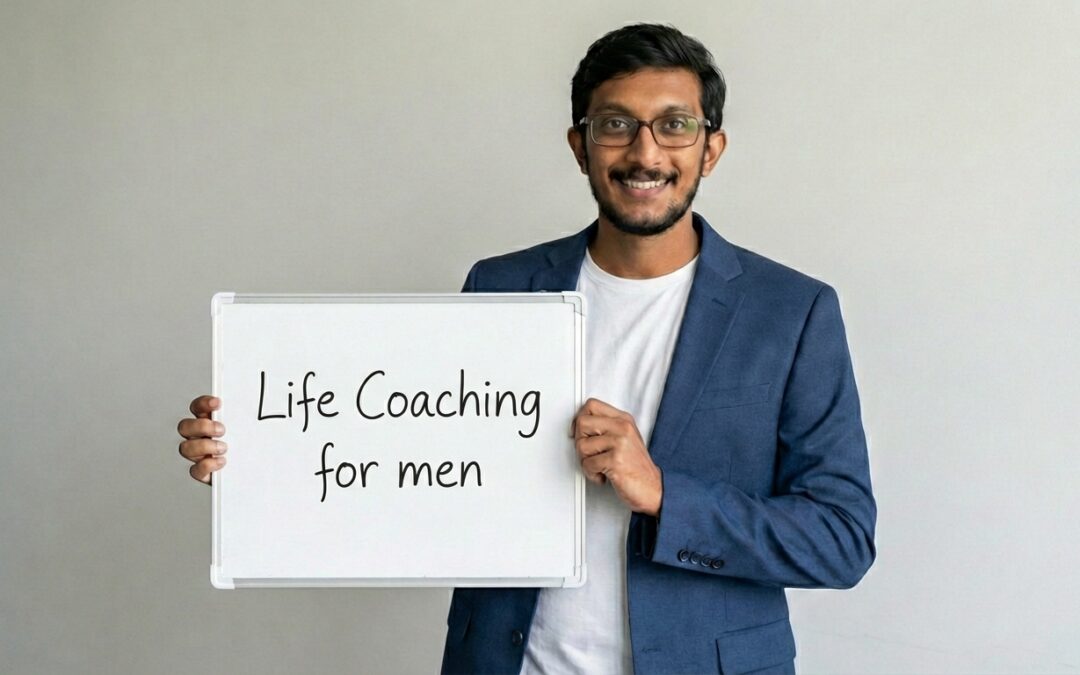
This guide on life coaching for men explores why men often stay silent, how coaching rebuilds confidence and resilience, and why safe spaces matter for men’s mental and emotional wellbeing. Learn how life coaching helps men break patterns, communicate better, and build healthier lives.
Contents
Introduction
The world today speaks more openly about emotional well-being and mental health, yet one group remains missing from many of these supportive spaces. Men. While the awareness around mental health grows globally, life coaching for men continues to be one of the most underused pathways to emotional support and personal growth.
I first attended a mental health support group session in India in 2020. Over the next several years, I continued going back to that same space. What struck me then and continues to strike me today is that I was often the only man in a room full of women. It was not because men did not need help. It was because very few men showed up to receive it.
Even the few who did attend would often slip into the space quietly, avoiding eye contact, hiding their face, almost as though they were embarrassed to be seen entering a clinic or a support group. The shame was visible. The fear was visible. The loneliness was visible. It soon opened doors to want get into life coaching as well as life coaching for men.
This made me reflect deeply on one question.
Why is it so hard for men to take help?
The answer lies in the way boys are raised. And the cost of that conditioning follows them into adulthood.
The Conditioning That Teaches Men Not to Ask for Help
From a very young age, boys are told that strength equals silence. Vulnerability is weakness. Tears are humiliation. Asking for help is disgraceful. The messaging is subtle at first, in expressions like “man up”, “boys do not cry”, and “be strong”. Over time, these become internal rules that guide how many men behave through their adult lives.
Historically, early tribal societies placed men as providers and women as nurturers. Today, both roles have evolved significantly. Women are becoming providers at an unprecedented rate and men are increasingly taking on nurturing responsibilities. Yet the expectations placed on men remain almost unchanged.
Being a homemaker still feels shameful for many men. Choosing a career path that does not follow the traditionally masculine script is still frowned upon. Showing softness, tenderness, or sensitivity still feels risky.
This rigid and outdated conditioning creates a harmful cycle.
Men are not allowed to express emotions.
Therefore, they never practice vulnerability.
Therefore, they do not seek support.
Therefore, they struggle alone.
Much of what we call toxic masculinity today stems from boys not being allowed to be children. Boys are pushed into roles that force them to be rough and tough, long before they are emotionally ready. We forget that men are grown boys and boys are children. Human development evolves through stages. We do not skip them.
This is where life coaching for men has immense value. It reopens doors that were shut early in life. It helps men rediscover parts of themselves they were conditioned to ignore.
The Emotional Cost of Silence for Men
Suppressing emotions for decades often shows up as:
• Unexplained anger
• Irritability
• Emotional disconnection
• Chronic stress
• Exhaustion
• Work burnout
• Anxiety and depression
• Difficulty expressing needs
• Relationship challenges
Most men who appear angry on the outside are often hurting deeply on the inside. Not because they lack emotional awareness but because they were never allowed to build it.
I remember a client who once told his boss he had severe back issues and needed to work from home. Instead of receiving empathy, he was mocked and humiliated in front of colleagues. What this reinforced for him was that speaking up only leads to punishment.
It is not that men do not try to speak.
It is when they do that the world often silences them.
This has contributed to rising suicide rates among men in many parts of the world. When a person feels they cannot express their pain without being judged, they start believing that suffering alone is their only option.
This is where life coaching for men becomes essential. It creates a safe and neutral environment where honesty is allowed and emotions are welcome.
This blog is written by Abhijit Shankaran, a certified life coach and mental fitness enabler. He is also
a content writer and digital marketing expert.
Why Life Coaching Helps Men Heal and Grow
1. A Safe, Judgment-Free Space
Coaching offers men a confidential and non judgmental environment where they can speak openly without fear of criticism or ridicule. For many men, this becomes the first space in their lives where emotional honesty is welcomed. Safety means different things for different men. For some, it is silence and privacy. For others, it is the reassurance that their emotions will not be dismissed. Many men have never been encouraged to express fear, confusion, or sadness, so having a coach who listens with patience helps them slowly unlearn the belief that vulnerability equals weakness. This supportive atmosphere gives men permission to finally exhale and be themselves.
2. Building Emotional Vocabulary
Many men know how to act but not how to name their emotions. Life Coaching for men helps translate feelings into words.
For example:
• “I am not angry. I am overwhelmed.”
• “I am not distant. I am anxious.”
• “I am not cold. I am afraid of failing.”
Naming emotions reduces the weight of carrying them alone.
3. Reduces Stigma Around Seeking Help
Some men resist therapy because they fear being labelled as broken or incapable. Coaching feels different because it focuses on clarity, goals, growth, and personal development rather than diagnosis. This makes it more approachable for men who find emotional conversations uncomfortable or intimidating. Since coaching often uses practical tools like reflection, planning, and action steps, men can view it as an investment in self improvement rather than a sign that something is wrong. This shift is powerful because it removes the shame attached to seeking support. Men begin to see help as a resource, not a threat to their identity.
4. Unlearning Harmful Conditioning
Life coaching for men helps them break out of restrictive beliefs like:
• Men must always be strong
• Men must never cry
• Men must always earn more
• Men must always know what to do
• Men must not show vulnerability
These beliefs hold men hostage more than they protect them.
5. Building Authentic Confidence
True confidence comes from self-awareness and emotional clarity, not from pretending to be strong or unaffected. Coaching helps men understand their needs, triggers, and patterns, which improves their ability to make decisions without fear or self-doubt. Through guided reflection and honest conversations, men learn how to communicate clearly, set healthier boundaries, and honour their values. This strengthens their relationships, work life, and sense of identity. Confidence becomes grounded in who they are rather than who they think they must be. This is why life coaching for men is not just beneficial. It is transformative.
This is why life coaching for men is not just beneficial. It is transformative.
Patriarchy Hurts Men Too
One of the biggest misconceptions is that patriarchy benefits all men. In reality, patriarchy was created to benefit those in power, not the majority of men.
Patriarchy expects all men to be:
• Strong
• Dominant
• Emotionally controlled
• Financially successful
• Always available for work
But most men do not fit these narrow definitions. Many men are compassionate, sensitive, intuitive, and nurturing. These qualities are natural and valid. Yet they are often suppressed out of fear of judgment.
After years of observing men in support spaces, I realized something important. Patriarchy does not empower men. It restricts them. Coaching helps men reclaim the parts of themselves that society taught them to hide.
How Life Coaching for Men Works
Men often respond differently to life coaching, and by extension, to any form of mental or emotional support. Many grow up being told that their value lies in being rational, strong, and unshakeable. This creates an exterior that appears logical but often hides layers of denial, confusion, or bottled emotions. Breaking through this protective shell requires a very intentional and sensitive approach. A coach working with men is not simply guiding a client. They are often guiding someone who has never been encouraged to speak openly about what they feel.
There are generally two broad groups of men who enter the coaching space. The first group consists of those who know they need help but do not know where to begin. They may sense that something is off, that life feels heavy or directionless, but they cannot articulate the core issue. They arrive curious but unsure, willing but slightly guarded. For them, coaching becomes a process of discovery. Each session helps them find language for emotions they have suppressed for years. They learn to name fear, frustration, loneliness, or disappointment. This is often the first step toward real change.
The second group includes men who will not open up until they feel completely safe. These are men who have been taught all their lives that vulnerability leads to shame, rejection, or punishment. They will analyze every interaction before trusting it. For them, safety is not just emotional. It is psychological, relational, and sometimes even physical. They need to know that their honesty will not be used against them. They need a coach who listens without judgment, who stays patient when they test boundaries, and who acknowledges the courage it takes to share even a single sentence.
Understanding these differences is not optional. It is essential. Safety means something unique to each man. For some, safety is privacy. For others, it is a gentle tone. For a few, it is structure and clarity. And for many, it is simply the assurance that they do not have to pretend.
Life coaching works best when men feel seen as humans rather than performers of strength. When they sense that the space allows confusion, fear, or uncertainty, their guard slowly lowers. With time, they begin to trust their own emotions rather than fighting them. They begin to accept that needing help is not a flaw. It is a human need.
Coaching meets men where they are. It does not force vulnerability. It invites it. It does not rush the process. It honours it. And in that slow, steady space of trust, men learn not only how to open up but how to stay open in their daily lives. This is where transformation begins.
Men respond differently to life coaching.
1. Identifying Core Emotional or Practical Challenges
Men often carry problems silently for years. Through coaching, they can finally speak about:
• Career pressure
• Relationship struggles
• Loneliness
• Fear of failure
• Stress and burnout
• Identity confusion
• Lack of purpose
Acknowledging the real problem is the starting point for change.
2. Building Emotional Resilience
Coaching helps men develop skills like:
• Mindfulness
• Emotional regulation
• Stress management
• Self awareness
• Healthy coping mechanisms
3. Setting Boundaries
Many men struggle to say no at work or home. Coaching helps them set boundaries without guilt.
4. Realigning Priorities and Purpose
Coaching helps men figure out what they truly want instead of what society expects from them.
5. Creating Actionable Plans
Instead of vague motivation, coaching provides structured steps that support real change.
Real Stories From Support Spaces
During the years I attended support group sessions, I met many men who:
• Entered quietly
• Tried not to be seen
• Avoided being recognized
• Hesitated before speaking
• Felt ashamed for needing help
Yet every time a man spoke, even a small sentence, it carried weight. It meant he had overcome years of conditioning to express himself in a room full of strangers.
Life coaching provides more of these spaces where men can speak freely and be heard.
Conclusion
The world is fast-moving, but not keeping space for the emotional well-being of men. Many men are trapped in outdated beliefs that force them to appear strong even when they are breaking inside. But help exists, support exists, and safe spaces exist.
Courage is not the absence of fear. It is choosing to seek help despite it.
If we want a healthier future where men thrive, not just survive, life coaching for men cannot remain an overlooked option. It must become accessible, normal, and encouraged.
Contact me
Get in touch with me for a personalized life coaching journey. Sessions are held online/offline.
To get started, reach out to me. My contact details are below
Abhijit Shankaran
Bengaluru, Serves globally
(+91) 8939920025
abhijitshankaran@gmail.com
Common Queries Answered
What is a life coach?
Why do I need a life coach?
Types of life coaching
Emotional intelligence coaching
Stress Management Strategies
Life Coaching for self-improvement
Top 10 Life Coaches in India
Does life coaching really work?
Life coaching for confidence building