My wife was glued to the sequel teaser and trailer of The Devil Wears Prada 2 jumping in excitement, and counting the days leading to the theatrical release on 1st May. I sat down to watch the first part on JioHotstar, to catch up on the movie fever and spent the rest of the countdown impersonating Meryl Streep’s iconic “That’s all”, while also googling the correct spelling of Gabbana.
We got tickets for the weekend morning show. Fewer people in the theatre, breakfast in the dark, the odd comfort of silence before the lights dimmed. I walked in expecting part two to be just as witty, humorous, and punchy. What I did not expect was the pitch of it all to feel so deafening, almost dissociative at moments. The last thing I wanted on a weekend morning was a conversation about layoffs, AI, and office politics. And yet, I could not have been happier that the film went exactly in that direction!
Without giving away spoilers to Devil Wears Prada 2, I want to touch upon a few of these themes to commend the sheer genius behind the writing.
Contents
What changed between the first and second Devil Wears Prada?
Technology.
From mobile phones to smartphones and programming to AI-driven systems, we’re heading into a reality that is pulling the chairs from under our feet and dancing over our heads.
With infinite choices online, an otherwise coveted printed publication like Runway, once the gold standard of fashion authority, is now just another piece of content, as Nigel says in Devil Wears Prada 2. Something scrolled past, skimmed, or skipped.
And it is not just fashion. Across industries, organisations are laying off, restructuring, and rethinking what a “lean team” truly means. With AI, it is now practical and possible to build an organisation with very few people, or in some cases none at all. Fully or nearly AI-driven. Somewhere along this transformation, one begins to wonder, where does art find the space to breathe into life?
Add to technology, the Devil Wears Prada 2 also explores office politics, which I would restrain myself from expanding to ensure there are no spoilers!
Watching Andrea, now a successful journalist played by Anne Hathaway, get laid off along with her team over a text message felt like a punch to the gut. It showed exactly where the world is headed. The pressure to stay relevant, updated, constantly running a race we know we cannot get ahead of or even win.
I nearly choked on my burger and instinctively grabbed my wife’s hand when something we were actively trying to forget appeared on a giant screen.
“Miranda” was not Miranda-ing
The boss lady was humbled. This was not the same character from Devil Wears Prada 1
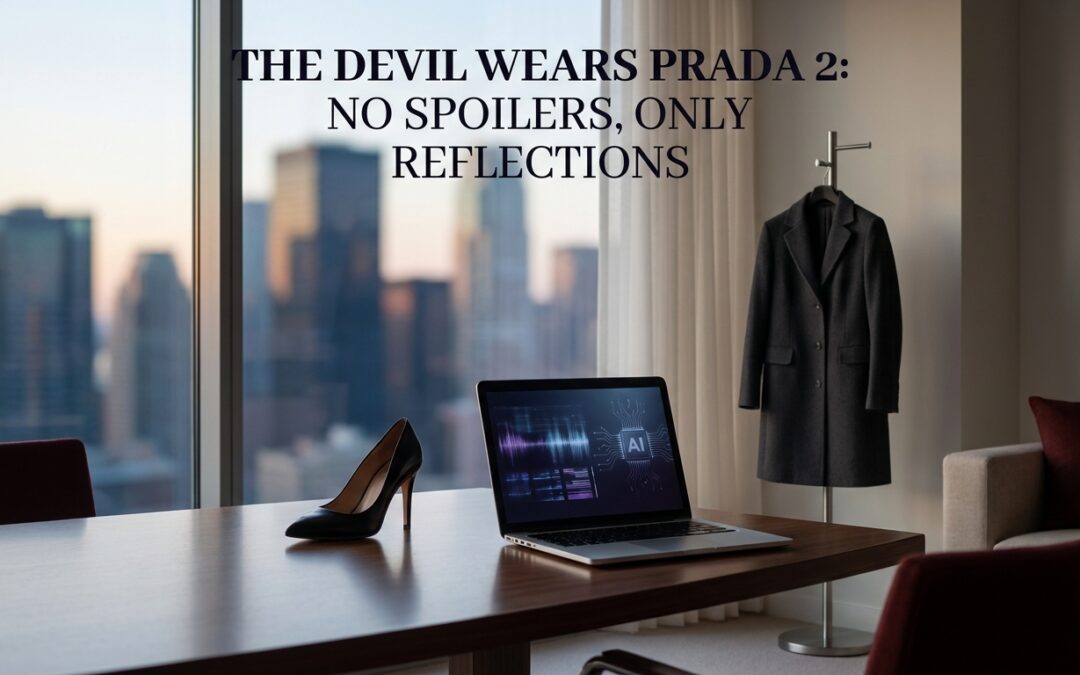
Several HR complaints later, Miranda had to be constantly reminded of her tone and choice of words in meeting rooms and discussions. Her diligent assistant ensured Miranda now thought twice before speaking. No more abruptly throwing bags onto someone else’s desk. Fewer rude, dismissive comments. The once-toxic queen hung her coat on the coat stand herself.
This Miranda lived in fear of losing her job. And so did everyone around her.
More reflective than we have ever seen her, the workaholic Miranda admits the cost of the life she chose. Ambitious, deeply invested in her work, loving her job more than anything else in the world. The devil, it turns out, did pay a price. But would she trade any of it away?
Probably not.
Emily and the baggage she carried
Emily, in part two, is more confident, more assured, and significantly ahead in her career. Yet beneath this robustness is a woman still wounded and bitter, struggling to feel whole.
Emily leaves Runway, builds a successful career, and yet remains unsatisfied. She wants revenge on Miranda for how she was treated while at Runway. She wants to climb the ladder, do whatever it takes to bring Miranda down. Filled with a rage many of us recognise too well at work, a sense of justice for being neglected, dismissed or humiliated at the workplace.
That sense of justice that is never met. Promotions that never come. Salary hikes that are postponed, dismissed, or quietly handed to someone else. Watching Emily carry that unresolved anger felt uncomfortably familiar. It is the kind of resentment that builds slowly, passed down through reviews, meetings, and euphemisms like “next cycle” and “visibility”.
Nigel, the ever-loyal soldier
Nigel could land a role anywhere. There is little doubt about that. He would be sought after, respected, and well compensated. And yet, despite the lack of a rope holding him there, he continues to anchor himself deeper into Runway.
Taken for granted by Miranda, the soldier keeps soldiering through with little success. But as her right hand, he finds something curiously powerful in that proximity. A strange sense of control that perhaps does not come easily elsewhere.
A mini Miranda, but kinder, more compassionate, even if not particularly loud. Nigel has a quiet language of care, especially when it comes to Andrea. He guides, warns, and protects in his own subtle ways. Loyalty, it seems, comes with both comfort and cost.
Andrea, same, same but same!
Financially independent. A great apartment. Strong network. Solid friendships. Andrea is everything part two promised she would be.
But unsurprisingly, the higher you climb, the harder you fall. And the more you have, the more you have to lose.
Layoffs and restructuring push her into panic mode. Frantic, disoriented, trying to find her footing. She wears a smile, because that is what we do, while quietly revisiting a part of herself she never imagined she would return to.
The past has a funny way of resurfacing when the future feels uncertain.
This blog is written by Abhijit Shankaran, a certified life coach and mental fitness enabler. He is also
a content writer and digital marketing expert.
Walking out heavier than I walked in: Devil Wears Prada 2
I walked into Devil Wears Prada 2 expecting a breezy, fast-paced comedy. I walked out heavier, reflective, and surprisingly moved. The film delivered a sharp message on power politics, organisational restructuring, technology impact and the emotional cost of ambition.
I interpret The Devil Wears Prada as something far more intimate than a caricature of an impossible boss. The devil, to me, is that part of us we hesitate to admit exists. The part that is power hungry, validation seeking, and willing to sacrifice relationships, health, and rest in pursuit of what the world celebrates as success. Productivity over rest. Results over process. Money over relationships. Power over people. These are not abstract ideas. They are reward systems we participate in, willingly or otherwise.
Prada, then, becomes the mask.
The polish. The aesthetic. The language. The carefully curated exterior allows the shadow to operate acceptably in plain sight. The ambition looks refined. The hunger looks professional. The exhaustion looks like dedication.
These layers from the shadow do not remain buried. They surface from time to time, holding up a cleanly polished mirror. We examine them briefly, flinch, and then gently push them back down, slipping the mask on once again and carrying on. The film, especially in part two, does not judge this behaviour. It simply reveals it.
What struck me most was how each of the four characters wears a different mask.
Miranda perhaps wears the least filtered one. She has always embodied power without apology. In Devil Wears Prada 2, that power is more restrained, more cautious, but still unmistakably hers. She knows the cost of ambition and accepts it without romanticism.
Nigel is the calmest on the outside. Poker-faced, composed, dependable. Beneath that exterior lies a deeply well put-together interior that few truly acknowledge. His mask is acceptance, loyalty, and quiet endurance.
Emily is clever in a way that survival demands. She knows how to read the room, play the long game, and manoeuvre around power rather than confront it head-on. Her mask is a strategy. Control. A belief that if she plays her cards well enough, justice will eventually come.
Andrea is perhaps the most unsettling, because she feels the most familiar. The connector. The one who says good morning first. The one who rallies people, builds bridges, and seems emotionally available. And yet, beneath that warmth lies a drive that pushes her into overdrive. A thirst for power and relevance that slowly tightens its grip. I cannot say more without spoiling it, but her arc feels like a quiet warning that there is a lot more to us that can be surprisingly haunting.
Through my life coaching practice, I often sit with clients as they wrestle with similar questions. While we cannot control the direction AI, technology, or organizations are taking, can we decide where we stop chasing? Can we recognize when ambition begins to cost more than it gives?
How much money, position, or authority do we really need before we feel secure. Before we feel at peace with ourselves. Before we allow ourselves to rest without guilt.
Perhaps that is the real sequel. Not the one on screen, but the one playing quietly within us, whenever the mask slips and the mirror catches our eye.
Finding the Found Program
The ‘Finding the Found‘ program is my flagship gentle 4-week life coaching program. There are 4 personalised 1:1 sessions, one per week. Each session focuses on each of the 4 stages mentioned in this blog – Awareness, Alignment, Action and Integration.
All sessions are held online. For offline sessions, please contact me, and we can work out a way to fulfil your request.
Contact me
Get in touch with me for a personalized life coaching journey. Sessions are held online/offline.
To get started, reach out to me. My contact details are below
Abhijit Shankaran
Bengaluru, Serves globally
(+91) 8939920025
abhijitshankaran@gmail.com
Common Queries Answered
What is a life coach?
Why do I need a life coach?
Types of life coaching
Emotional intelligence coaching
Stress Management Strategies
Life Coaching for self-improvement
Top 10 Life Coaches in India
Does life coaching really work?
Life coaching for confidence building