
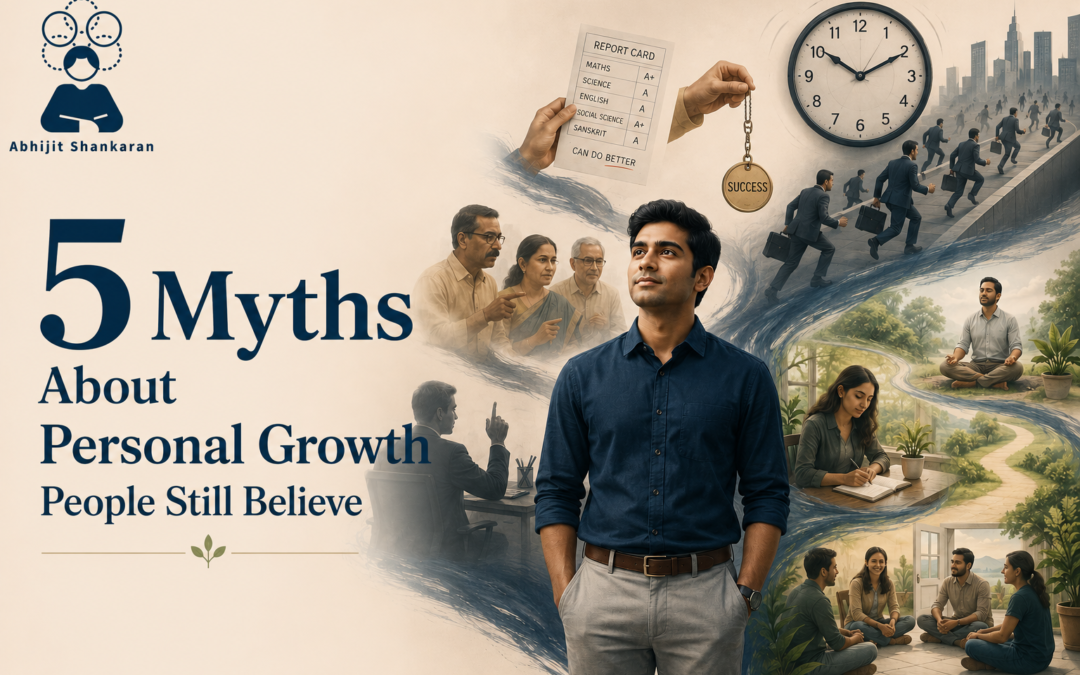
For many of us in India, growth has never been a private experience.
From the time we enter school, our progress is measured, discussed, compared, and sometimes announced to relatives before we have even had time to understand it ourselves.
- How many marks did you score?
- What rank did you get?
- Which college did you join?
- What package did you receive?
- When are you getting promoted?
- When are you buying a house?
- When are you getting married?
- Life begins to feel like one long report card.
This blog is written by Abhijit Shankaran, a certified life coach and mental fitness enabler. He is also
a content writer and digital marketing expert.
As young professionals, we often carry this conditioning into the workplace. We measure a good day by how many tasks we completed, how many hours we worked, or how visibly busy we appeared. We may even feel guilty while resting because rest does not look productive.
This is one reason Personal Growth can become another performance.
Instead of helping us understand ourselves, it becomes one more area in which we must prove that we are improving fast enough. We read books, join courses, listen to podcasts, follow routines, and chase a version of ourselves that always seems slightly out of reach.
But what if some of what we believe about growth is not true?
What if these ideas come from social conditioning rather than genuine self-awareness?
Here are five myths about Personal Growth that many of us still carry.
Contents
- 0.1 Myth 1: Personal Growth Means Becoming More Productive
- 0.2 Myth 2: Personal Growth Should Produce Quick Results
- 0.3 Myth 3: Personal Growth Requires Constant Motivation
- 0.4 Myth 4: Personal Growth Is a Solo Journey
- 0.5 Myth 5: Personal Growth Means Becoming Someone Else
- 0.6 What Personal Growth Actually Looks Like
- 0.7 Begin With One Honest Question
- 1 Frequently Asked Questions
Myth 1: Personal Growth Means Becoming More Productive
Many of us are conditioned to believe that our value depends on how much we accomplish.
This conditioning begins early.
From the first standard onward, we receive report cards that reduce an entire year of learning to marks, grades, ranks, and teacher comments. Over time, we begin to evaluate ourselves in the same way.
Did I achieve enough today?
Was I productive?
Did I use my time well?
Did I waste the afternoon?
This way of thinking follows us into adulthood. A busy day feels successful. A slow day feels irresponsible. Rest becomes something we must earn after completing enough work.
In many Indian homes, rest is often confused with laziness.
A child sitting quietly may be asked why they are wasting time. A college student taking a break may be reminded about exams. A working professional visiting home may be questioned about career plans before they have finished their tea.
Parents, teachers, neighbours, relatives, and the occasional uncle who visits once every few months may all feel qualified to comment on how we should be using our lives.
Shame often becomes the tool used to keep us moving.
“Look at Sharmaji’s son.”
“You have so much potential, but you are wasting it.”
“At your age, we already had responsibilities.”
“You should be grateful. Why are you tired?”
These statements may come from concern, but they teach us to disconnect from our own needs.
Real Personal Growth is not about increasing your daily output.
It is about becoming aware of what drives you, what drains you, and what kind of life you are actually trying to build.
Sometimes growth looks like completing an important project. At other times, it looks like taking an afternoon off before your body forces you to stop.
Rest is not a reward for exhaustion. It is a basic human need.
A healthy relationship with Personal Growth allows you to value yourself even on the days when you are not producing, achieving, or proving anything.
Myth 2: Personal Growth Should Produce Quick Results
We live as though we are constantly running late.
You can see it in everyday situations.
A flight lands, and before the seat belt sign has switched off, passengers begin opening overhead compartments. People stand in the aisle even though the aircraft door is still closed. Bags are pulled down, phones are checked, and everyone prepares to rush out.
There may be no emergency. No connecting flight. No urgent reason to move.
Still, the body behaves as though every second matters.
The same pattern appears on roads, in queues, at office lifts, and while boarding trains. We rush even when rushing does not take us anywhere faster.
Many of us have been conditioned to participate in an invisible race.
We must complete school quickly, enter the right college, secure a job, receive a promotion, get married, buy property, and establish ourselves before an imagined deadline.
This urgency enters our relationship with Personal Growth.
We expect confidence after attending one workshop. We expect clarity after one coaching session. We expect a new habit to become effortless within a few days.
When change takes longer, we assume something is wrong.
But meaningful change is rarely immediate.
Your mind and body may have spent years learning to remain alert, avoid mistakes, seek approval, or prepare for criticism. These patterns do not disappear simply because you have understood them intellectually.
You may know that you need to slow down, yet still feel restless while doing nothing. You may know that comparison is unhelpful, yet still feel anxious when a colleague is promoted.
That does not mean you are failing.
It means your nervous system may still be responding to an environment in which slowing down once felt unsafe.
Personal Growth is not an express-delivery service. It unfolds through awareness, repetition, and patience.
Progress may look like noticing the urge to rush before acting on it. It may look like pausing before saying yes to another responsibility. It may look like allowing yourself to take time without explaining or apologising.
The goal is not to win the invisible race. It is to recognise that you do not have to participate in it.
Myth 3: Personal Growth Requires Constant Motivation
Motivation and commitment are not the same thing.
Motivation is often like a carrot held in front of us. We keep moving because we believe a reward is waiting at the end.
This pattern also begins in childhood.
Score the highest marks, and you may receive chocolate.
Top the class, and your name may be announced during assembly.
Perform well in college, and you may receive a certificate, scholarship, or placement opportunity.
From school to the workplace, the person at the top is celebrated. The highest scorer, best performer, star employee, and fastest-growing professional become examples for everyone else.
Rewards are not inherently harmful. The problem begins when achievement becomes the only accepted proof of worth.
We begin to ask whether we are impressive enough rather than whether our work is meaningful.
We may also confuse the ability to follow a set of metrics with genuine ability or intelligence.
A person may perform exceptionally well because they understand what the system rewards. They know how to prepare for an exam, meet a target, impress a manager, or follow established rules.
But does that performance reflect the full value of the person?
Or does it sometimes reflect their ability to align with standards created by an institution, workplace, or society?
Many of these rules are presented as though they are set in stone.
Study this subject.
Choose this career.
Reach this designation.
Earn this salary.
Follow this path.
When motivation depends entirely on external rewards, it disappears when the reward is no longer attractive.
Commitment works differently.
Commitment is the decision to continue because the action matters to you. It does not require excitement every day.
You may not feel motivated to have a difficult conversation, but you remain committed to honesty. You may not feel inspired to work on a new skill after a long day, but you remain committed to developing it slowly.
Sustainable Personal Growth depends more on commitment than motivation.
Motivation asks, “What will I receive?”
Commitment asks, “What matters enough for me to continue?”
This shift helps you build a life around your values rather than around applause, rankings, and rewards.
Myth 4: Personal Growth Is a Solo Journey
Modern work culture often celebrates the self-made individual.
We are encouraged to become financially independent, emotionally self-sufficient, professionally competitive, and personally responsible for every outcome.
Capitalism has strengthened this culture of individuation. We are taught to market ourselves, build our personal brands, expand our networks, and constantly improve our individual value.
Financial freedom and personal space are valuable. They can give us choice, safety, and dignity.
But independence does not remove our need for connection.
We still carry the memory of community.
Indian life has traditionally included shared spaces, extended families, neighbourhood relationships, festivals, collective meals, and an instinct to look out for one another.
This does not mean every community is healthy or that family systems are always supportive. It means human beings are social by nature.
We need more than professional networking.
Networking often carries an agenda. We exchange numbers, connect on LinkedIn, and remain in touch because the relationship may become useful during a job change, business opportunity, or referral.
Connection is different.
Connection allows us to be present without calculating future value. It gives us a collective sense of identity. It reminds us that we belong somewhere even when we are not performing.
This need is not weakness. It is not dependency. It is part of being human.
An elephant survives with its herd. A child develops through relationships. Adults also need people who witness their lives, share their struggles, and remind them that they are not alone.
Personal Growth does not have to happen in isolation.
Sometimes another person helps you see a pattern you cannot recognise on your own. A friend may notice that you become silent around authority. A colleague may help you understand that your workload is unreasonable. A coach may help you separate your own desires from social expectations.
Growth may be personal, but it is often relational.
We do not become ourselves by withdrawing from everyone. We often discover ourselves through honest, safe, and meaningful relationships.
Myth 5: Personal Growth Means Becoming Someone Else
Every system needs people who fit into it.
Workplaces need employees who follow structures. Markets need consumers who continue wanting more. Social groups need members who behave in familiar and predictable ways.
This can create a quiet conflict.
What happens when a person begins to grow from within?
What happens when they stop chasing a prestigious title they never wanted? What happens when they question a lifestyle built entirely around earning and spending? What happens when they no longer want to perform a version of success that benefits everyone except themselves?
If every person fully blossomed into their own expression, many established systems would be forced to change.
This is one reason conformity is often rewarded.
Human beings naturally want to fit in. Belonging has always mattered to our survival. Like an elephant moving with its herd, we look for safety in being part of a group.
But this natural need can also be used against us.
We begin adjusting ourselves to fit expectations that are too small for us.
It is like trying to force a large hand into a tiny glove. We push harder, blame the hand, and assume we are the problem. We rarely stop to ask whether the glove was ever the right size.
A creative person may force themselves into a predictable career because it appears respectable. A sensitive manager may become unnecessarily aggressive because leadership is associated with dominance. A young professional may continue chasing promotions while quietly feeling disconnected from the work.
Over time, we forget that we are adapting.
We call it maturity.
We call it responsibility.
We call it being practical.
But genuine Personal Growth is not about becoming a more acceptable version of yourself.
It is about recognising where you have reduced, silenced, or reshaped yourself to belong.
This does not mean rejecting society, quitting your job impulsively, or refusing every responsibility. It means making conscious choices instead of automatically following a script.
You may continue in the same career, but redefine success. You may remain ambitious, but stop treating exhaustion as a badge of honour. You may value financial security while refusing to measure your entire identity through income.
Growth does not always change your outer life immediately.
Sometimes it changes the person making the choices.
What Personal Growth Actually Looks Like
Real growth is usually less dramatic than the version sold to us.
It may look like resting without guilt.
It may look like leaving a WhatsApp message unanswered until you have the emotional energy to respond.
It may look like choosing not to explain your career decision to every relative.
It may mean recognising that your salary is important, but it is not a measure of your worth.
It may mean learning to be part of a community without losing your individuality.
It may also mean questioning rules that you have followed for years.
Why do I need to stay busy?
Why am I rushing?
Whose approval am I seeking?
Would I still want this goal if nobody knew I had achieved it?
These questions may feel uncomfortable because they challenge ideas we have inherited from family, school, work, and society.
That discomfort is part of Personal Growth.
The objective is not to reject everything you have been taught. It is to examine it.
Some beliefs may still serve you. Others may have helped you survive one stage of life but no longer belong in the next.
Growth begins when you learn to tell the difference.
Begin With One Honest Question
You do not need to transform your entire life today.
Begin with one honest question:
What am I doing because it matters to me, and what am I doing because I am afraid of falling behind?
Sit with the answer before trying to fix it.
You may discover that your tiredness is not laziness. Your lack of motivation may not be a character flaw. Your need for connection may not be dependency. Your discomfort may be a sign that you have been trying to fit into a life that does not fully belong to you.
Personal Growth is not about becoming endlessly productive, permanently motivated, completely independent, or socially acceptable.
It is about becoming more aware of who you are beneath the conditioning.
Once you begin questioning the myths, Personal Growth becomes less about performing improvement and more about living with clarity, commitment, connection, and self-trust.
Frequently Asked Questions
What does Personal Growth mean in an Indian context?
It means examining how family expectations, education, social comparison, work culture, and ideas about success have shaped your choices. It also means deciding which beliefs still support the life you want to build.
Is productivity the same as Personal Growth?
No. Productivity measures output. Growth includes self-awareness, emotional maturity, healthier relationships, better boundaries, and the ability to make conscious decisions.
Why do I feel guilty when I rest?
Many people are taught that rest must be earned. When achievement becomes connected to worth, inactivity can create guilt even when the body genuinely needs recovery.
Can I grow without feeling motivated?
Yes. Motivation naturally changes. Commitment, supportive routines, meaningful relationships, and a clear sense of purpose are often more reliable.
Does Personal Growth require becoming independent?
Healthy independence is valuable, but complete self-sufficiency is neither realistic nor necessary. Human beings need connection, support, belonging, and community.
Finding the Found Program
The ‘Finding the Found‘ program is my flagship gentle 4-week life coaching program. There are 4 personalised 1:1 sessions, one per week. Each session focuses on each of the 4 stages mentioned in this blog – Awareness, Alignment, Action and Integration.
All sessions are held online. For offline sessions, please contact me, and we can work out a way to fulfil your request.
Contact me
Get in touch with me for a personalized life coaching journey. Sessions are held online/offline.
To get started, reach out to me. My contact details are below
Abhijit Shankaran
Bengaluru, Serves globally
(+91) 8939920025
abhijitshankaran@gmail.com
Common Queries Answered
What is a life coach?
Why do I need a life coach?
Types of life coaching
Emotional intelligence coaching
Stress Management Strategies
Life Coaching for self-improvement
Top 10 Life Coaches in India
Does life coaching really work?
Life coaching for confidence building
Common Search Terms Answered
personal development in India
Indian work culture
productivity culture
self-worth and achievement
community and belonging
limiting beliefs
young Indian professionals
emotional well-being
sustainable growth
social conditioning