
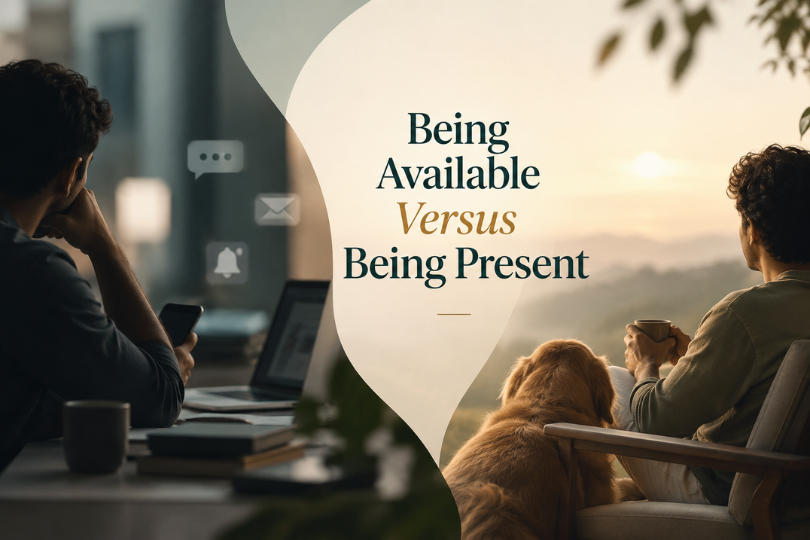
Being available is not the same as being present.
I learnt this via a very insightful encounter with a family I met for lunch.
As we spoke, the parents shared proudly that they had created a healthy work-life balance. They had successful corporate careers, maintained clear work boundaries and made time for their child. They attended sports days, helped with homework and remained available whenever their child needed them.
From the outside, everything seemed to be working well. Yet, something made me curious. Later, when I had an opportunity to speak to the child privately, I gently asked how they were really doing.
Their response stayed with me:
“My parents are always available, but they are not always present.”
It was not an accusation. The child knew their parents loved them and were doing their best. At the same time, the child carried the pain of having caring people nearby and still not feeling fully seen or heard.
This experience taught me something important about being present in relationships:
Availability can make us accessible, but presence is what helps another person feel emotionally safe.
Contents
- 1 What Is the Difference Between Being Available and Being Present?
- 2 Why Can Someone Feel Unseen in a Loving Family?
- 3 The Need to Feel Seen and Heard
- 4 How Our Conditioning Affects Emotional Presence
- 5 What Does Emotional Presence Look Like in Everyday Life?
- 6 A Life Coaching Perspective on Relationships
- 7 Presence Is a Relationship Practice
- 8 Finding the Found Program
- 9 Contact me
- 10 Follow me
What Is the Difference Between Being Available and Being Present?
Being available often means showing up physically or functionally. We answer the phone, attend an event, solve a problem, give advice or complete a responsibility. These actions matter. They communicate reliability and care.
Being emotionally present, however, asks something more of us. It means entering another person’s reality with curiosity, empathy and as little judgement as possible. It means listening not only for facts, but also for the emotion beneath the words. Instead of immediately correcting, comparing or fixing, we try to understand.
Availability says, “I am here if you need something.”
Presence says, “I want to understand what this is like for you.”
Why Can Someone Feel Unseen in a Loving Family?
As the conversation continued, the child spoke about school pressure, appearance-related insecurities, friendships, peer pressure and the fear of not getting into a good college. None of these struggles were unusual. What felt lonely was the belief that their parents would view these experiences through a very different lens.
The parents’ world had been shaped by their childhood, responsibilities and ideas about success. Their child was growing up in a world very different from their parents – one influenced by social media, constant comparison and changing career paths.
Problems begin when we assume that love gives us complete access to another person’s inner world. We may care deeply and still misunderstand. We may say, “This is not a big issue,” hoping to reassure someone, while they hear, “Your feelings do not make sense.”
Over time, a person can learn to share less. They may seem calm, responsible and independent while quietly concluding that their emotions are too much, their struggles are not important or they must deal with everything alone.
The Need to Feel Seen and Heard
Feeling seen and heard is a core emotional need in any meaningful relationship between a parent and child, partners, friends, siblings or colleagues.
At the end of my conversation with the child, I asked what I could do to help. They said I already had. I had followed them into their world with curiosity, treated them with respect and listened without judgement.
I did not solve the pressures they faced. For that moment, being present was enough.
To feel seen is to sense that someone recognises our experience rather than only evaluating our behavior.
To feel heard is to know that our words have been received without immediately being dismissed or turned into advice.
This does not mean agreeing with everything another person says. Presence is not the absence of boundaries, disagreement or accountability. It is the willingness to understand before responding.
How Our Conditioning Affects Emotional Presence
Many of us were taught to express care through action: provide, protect, advise, solve and sacrifice. We may not have been taught how to sit with discomfort, name emotions or listen without trying to change what another person feels.
As a result, we may offer solutions before understanding the problem, compare someone’s pain with a harder experience or listen while preparing our response. We may even interpret a different perspective as disrespect or rejection.
These patterns do not necessarily make us uncaring. Often, they reflect how we learned to relate to our own emotions. If sadness, fear or uncertainty were unwelcome in our childhood, we may struggle to remain present when someone else expresses them.
This is where self-awareness becomes central to healthier relationships. The more honestly we understand our triggers, assumptions and limiting beliefs, the more choice we have in how we respond.
This blog is written by Abhijit Shankaran, a certified life coach and mental fitness enabler. He is also
a content writer and digital marketing expert.
What Does Emotional Presence Look Like in Everyday Life?
Emotional presence does not require a dramatic heart-to-heart conversation every day. It can mean putting the phone aside when someone begins sharing or asking, “Do you want advice, or would you like me to listen?” Instead of saying, “You are overthinking,” we might ask, “What about this feels most difficult?”
Sometimes presence means reflecting what we heard: “It sounds like you are under pressure and worried about disappointing us.” This can help someone feel understood, even without an immediate solution.
Presence also asks us to respect the other person as an individual, with an inner world that may be very different from ours.
A Life Coaching Perspective on Relationships
Life coaching does not provide a script for becoming the perfect parent, partner or friend. It can, however, create space to notice how we show up in relationships.
Through reflection, we can explore questions such as:
- Do I listen to understand, or to respond?
- What emotions make me uncomfortable?
- When someone shares a struggle, do I become curious or defensive?
- Am I making space for their reality, or asking them to fit into mine?
- What belief about myself gets activated when I cannot solve their problem?
These questions are not meant to produce guilt. They invite awareness. From awareness, we can reframe old beliefs, choose a more aligned response and practise it in everyday interactions. This reflects the personalised work I support through one-to-one life coaching: moving from automatic patterns towards greater clarity, confidence and intentional action.
Presence Is a Relationship Practice
I am not a parent, and I do not share this story as a judgement of parenting. I share it because I have heard similar feelings from friends, peers and adults reflecting on their childhoods. The lesson extends far beyond work-life balance or family life.
We can meet every responsibility and still miss the person in front of us. We can attend the event, answer the call and offer help, yet never quite enter their emotional world.
Being present in relationships is not something we perfect once. It is a continuing practice of slowing down, becoming curious and allowing another person’s experience to exist without immediately reshaping it.
A calendar can remind us to show up. Only attention, empathy and respect can help another person feel safe, heard and seen.
Sometimes, the most meaningful thing we can say is not, “Here is what you should do.”
It is simply, “Help me understand your world.”
Finding the Found Program
The ‘Finding the Found‘ program is my flagship gentle 4-week life coaching program. There are 4 personalised 1:1 sessions, one per week. Each session focuses on each of the 4 stages mentioned in this blog – Awareness, Alignment, Action and Integration.
All sessions are held online. 1 hour per session. For offline sessions, please contact me, and we can work out a way to fulfil your request.
For clients interested in long-term work, I am happy to extend beyond the 4 sessions as well.
Contact me
Get in touch with me for a personalized life coaching journey. Sessions are held online/offline.
To get started, reach out to me. My contact details are below
Abhijit Shankaran
Bengaluru, Serves globally
(+91) 8939920025
abhijitshankaran@gmail.com
Follow me
Follow me on instagram